Background knowledgeConocimientos previos2 skills you need for today: Work inside parentheses first · Find the greatest common factor (GCF)Las 2 destrezas que necesitas hoy: Resolver primero lo que está entre paréntesis · Hallar el máximo común divisor (MCD)
The Distributive PropertyLa propiedad distributiva:Multiply a factor by every term inside parentheses.Multiplicar un factor por cada término dentro de los paréntesis.
Read the words below.Lee las palabras de abajo.
Open the model and change one number at a time.Abre el modelo y cambia un número a la vez.
Answer the questions beside the model, one at a time.Responde las preguntas junto al modelo, una a la vez.
Words to knowPalabras clave
Distributive PropertyPropiedad distributiva
Multiplying a number by everything inside the parentheses: a(b + c) = ab + ac.Multiplicar un número por todo lo que está dentro del paréntesis: a(b + c) = ab + ac.
3(4 + 5) = 3×4 + 3×5 = 12 + 15 = 27 — the 3 gets 'distributed' to both the 4 and the 5
Factor
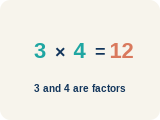
A factor of a whole number divides it evenly, with no remainder. For example, 3 is a factor of 12 because 12 ÷ 3 = 4.Un factor de un número entero lo divide exactamente, sin dejar residuo. Por ejemplo, 3 es un factor de 12 porque 12 ÷ 3 = 4.
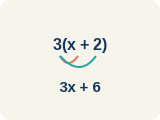
In 3(x + 2), the 3 is the factor outside the parentheses that multiplies each term inside
ExpandDesarrollar
To multiply out the parentheses in an expression.Multiplicar lo que está dentro del paréntesis en una expresión.
Expand 2(n + 6): multiply 2 × n = 2n and 2 × 6 = 12, so 2(n + 6) = 2n + 12
EquivalentEquivalente
Expressions that always have the same value.Expresiones que siempre tienen el mismo valor.
3(x + 4) and 3x + 12 always give the same answer: when x = 2, both = 18; when x = 10, both = 42
Loading the model…
1. Try this1. Prueba esto
Expand 3(x + 4). Explain why both terms inside receive the factor 3.
Compare the expanded and grouped forms at two values of x.
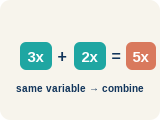
Explain why 3x + 12 cannot be combined into 15x.
3. Check yourself3. Compruébalo
Answer a question about your model, then one new problem without it.Responde una pregunta sobre tu modelo y luego un problema nuevo sin él.
Read the idea, follow the worked examples, and connect the picture to the numbers.Lee la idea, sigue los ejemplos resueltos y conecta el dibujo con los números.
1Step 1 of 9:Paso 1 de 9:Words to knowPalabras clave
Say what each word means, then tap the card to check.Di qué significa cada palabra y luego toca la tarjeta para comprobar.
2Step 2 of 9:Paso 2 de 9:Check the wordsComprueba las palabras
3Step 3 of 9:Paso 3 de 9:What is the distributive property?¿Qué es la propiedad distributiva?
The distributive property means you can multiply a number by everything inside the parentheses, one piece at a time: a(b + c) = ab + ac.La propiedad distributiva significa que puedes multiplicar un número por todo lo que está dentro del paréntesis, parte por parte: a(b + c) = ab + ac.
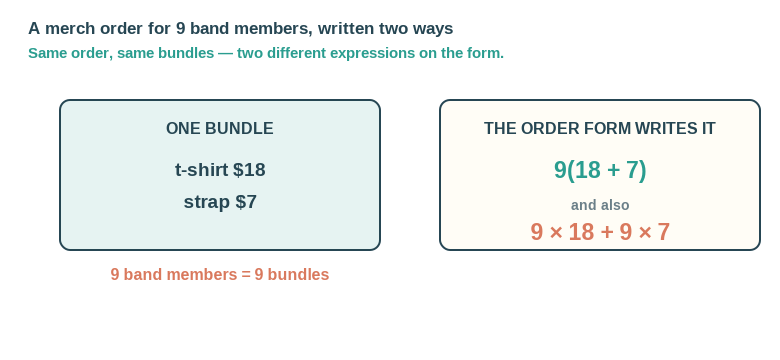
The studio manager is ordering merch bundles for 9 band members going on tour. Each bundle includes a t-shirt ($18) and a strap ($7). The order form writes the cost two ways: 9(18 + 7) and 9 × 18 + 9 × 7.El gerente del estudio está pidiendo paquetes de mercancía para 9 integrantes de la banda que salen de gira. Cada paquete incluye una camiseta ($18) y una correa ($7). La forma de pedido escribe el costo de dos maneras: 9(18 + 7) y 9 × 18 + 9 × 7.
4Step 4 of 9:Paso 4 de 9:Watch meMírame
Watch me
Each bundle has a ticket ($15) and a snack ($5). For 3 bundles I can write 3(15 + 5).Cada paquete tiene un boleto ($15) y un refrigerio ($5). Para 3 paquetes puedo escribir 3(15 + 5).
Way 2: distribute the 3 to each part. 3 × 15 + 3 × 5.Manera 2: distribuir el 3 a cada parte. 3 × 15 + 3 × 5.
That is 45 + 15 = 60.Eso es 45 + 15 = 60.
Both ways give $60, so 3(15 + 5) = 3 × 15 + 3 × 5.Las dos maneras dan $60, así que 3(15 + 5) = 3 × 15 + 3 × 5.
5Step 5 of 9:Paso 5 de 9:Let’s do one togetherHagamos uno juntos
Before each step, say what you think comes next. Then show it.Antes de cada paso, di qué crees que sigue. Luego muéstralo.
Let's try together
Let's expand 2(8 + 3). Where does the 2 go?Expandamos 2(8 + 3). ¿A dónde va el 2?
We multiply the 2 by each term: 2 × 8 + 2 × 3.Multiplicamos el 2 por cada término: 2 × 8 + 2 × 3.
That is 16 + 6 = 22. So 2(8 + 3) = 22.Eso es 16 + 6 = 22. Entonces 2(8 + 3) = 22.
6Step 6 of 9:Paso 6 de 9:Your turnTu turno
Now it's your turn
In the table, expand each expression using the distributive property, then simplify.En la tabla, expande cada expresión usando la propiedad distributiva y luego simplifica.
7Step 7 of 9:Paso 7 de 9:Check yourself: a first questionCompruébalo: una primera pregunta
8Step 8 of 9:Paso 8 de 9:Check yourself: a harder questionCompruébalo: una pregunta más difícil
9Step 9 of 9:Paso 9 de 9:Put it togetherJúntalo todo
Watch out for a common mistakeCuidado con un error común
The most common mistake in The Distributive Property is multiplying the outside factor by only the FIRST term inside the parentheses and forgetting the second — for example, writing 3(x + 4) = 3x + 4 instead of 3x + 12. Before you submit, check: did the outside number reach BOTH terms inside the parentheses?
Sentence frameMarco de oración
When I distribute, I multiply the outside factor ___ by each term ___. The operation inside the parentheses ___ stays the same.Cuando distribuyo, multiplico el factor de afuera ___ por cada término ___. La operación de adentro del paréntesis ___ se queda igual.
Stage 3 of 5Etapa 3 de 5
PracticePractica
Choose Regular or Challenge. Hints come one step at a time; you get a new question after a worked example.Elige Regular o Reto. Las pistas llegan paso a paso; después de un ejemplo resuelto recibes una pregunta nueva.
Loading practice…
Stage 4 of 5Etapa 4 de 5
ApplyAplica
Use the idea in a real situation. Write your reasoning, then compare it with a sample.Usa la idea en una situación real. Escribe tu razonamiento y compáralo con un ejemplo.
Apply in context: Pencil boxesAplica en contexto: Cajas de lápices
A school buys 7 boxes of pencils with 38 pencils in each box. Use the distributive property by writing 38 as 40 − 2. Then find the total number of pencils.Una escuela compra 7 cajas de lápices con 38 lápices en cada caja. Usa la propiedad distributiva escribiendo 38 como 40 − 2. Luego halla el total de lápices.
Step 1 · Guide mePaso 1 · Guíame
What is 7 × 40?¿Cuánto es 7 × 40?
Step 2 · Final answerPaso 2 · Respuesta final
pencilslápices
Real-world connectionConexión con el mundo real
A music studio is ordering supplies for 8 practice rooms. Each room needs a music stand ($12) and a stool ($9). The total cost can be written as 8(12 + 9).Un estudio de música está pidiendo equipo para 8 salas de práctica. Cada sala necesita un atril ($12) y un banco ($9). El costo total se puede escribir como 8(12 + 9).
Distributing 8(12 + 9)Distribuyendo 8(12 + 9)
Each row is one product from distributing the 8 — stands (8×$12=$96) and stools (8×$9=$72) — and together they fill the $168 total, showing 8(12+9)=8×12+8×9.Cada fila es un producto de distribuir el 8 — atriles (8×$12=$96) y bancos (8×$9=$72) — y juntos llenan el total de $168, mostrando que 8(12+9)=8×12+8×9.
Question:Pregunta:Use the distributive property to find the total cost. Which way of calculating is easier for you?Usa la propiedad distributiva para hallar el costo total. ¿Qué manera de calcular te resulta más fácil?
8(12 + 9) = 8 × + 8 × = + = . I think the form is easier because .8(12 + 9) = 8 × + 8 × = + = . Yo creo que la forma es más fácil porque .
Reasoning challengeReto de razonamiento
Use the distributive property to explain why 6 × 98 can be calculated as 6 × 100 − 6 × 2 = 588. Then create your own example of using the distributive property to make multiplication easier.Usa la propiedad distributiva para explicar por qué 6 × 98 se puede calcular como 6 × 100 − 6 × 2 = 588. Después crea tu propio ejemplo de cómo usar la propiedad distributiva para hacer más fácil una multiplicación.
Create & verify: The Distributive PropertyCrea y verifica
Write an expression in the form a(bx + c) and expand it with the Distributive Property. Then write a sum like 18y + 24 and factor it back into a(bx + c) form.Escribe una expresión de la forma a(bx + c) y expándela con la propiedad distributiva. Luego escribe una suma como 18y + 24 y factorízala a la forma a(bx + c).
Quick test bench (try numbers or expressions)Banco de prueba rápido (prueba números o expresiones)
Stage 5 of 5Etapa 5 de 5
ReflectReflexiona
Answer on your own. Your first try counts as independent evidence; you can still revise.Responde por tu cuenta. Tu primer intento cuenta como evidencia independiente; todavía puedes revisar.