Background knowledgeConocimientos previos2 skills you need for today: Repeated multiplication is not repeated addition · Multiply by 10 again and againLas 2 destrezas que necesitas hoy: Multiplicar varias veces no es sumar varias veces · Multiplicar por 10 una y otra vez
Powers and ExponentsPotencias y exponentes:A power uses a base and an exponent to show repeated multiplication.Una potencia usa una base y un exponente para mostrar multiplicación repetida.
Read the words below.Lee las palabras de abajo.
Open the model and change one number at a time.Abre el modelo y cambia un número a la vez.
Answer the questions beside the model, one at a time.Responde las preguntas junto al modelo, una a la vez.
Words to knowPalabras clave
ExponentExponente
A small number that tells how many times to multiply a number by itself.Un número pequeño que dice cuántas veces multiplicar un número por sí mismo.
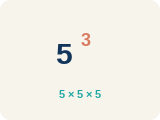
In 2³, the small 3 means multiply 2 by itself 3 times: 2 × 2 × 2 = 8
Base
The number that gets multiplied by itself.El número que se multiplica por sí mismo.
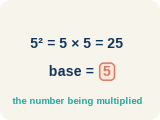
In 5², the base is 5 — it is the number being multiplied: 5 × 5 = 25
PowerPotencia
A number written with a base and an exponent, like 2³.Un número escrito con una base y un exponente, como 2³.
10³ = 10 × 10 × 10 = 1,000 — read as '10 to the third power' or '10 cubed'
EvaluateEvaluar
To find the value by putting numbers in for the letters.Encontrar el valor poniendo números en lugar de las letras.
Evaluate 3⁴: write 3 × 3 × 3 × 3, then multiply step by step: 9 × 9 = 81
Loading the model…
1. Try this1. Prueba esto
Compare 3⁴ with 3 × 4. Expand the power to explain the difference.
Predict 2 + 3⁴ before evaluating. Which operation comes first?
Change the exponent by one and explain the multiplicative effect on the power.
3. Check yourself3. Compruébalo
Answer a question about your model, then one new problem without it.Responde una pregunta sobre tu modelo y luego un problema nuevo sin él.
Read the idea, follow the worked examples, and connect the picture to the numbers.Lee la idea, sigue los ejemplos resueltos y conecta el dibujo con los números.
1Step 1 of 9:Paso 1 de 9:Words to knowPalabras clave
Say what each word means, then tap the card to check.Di qué significa cada palabra y luego toca la tarjeta para comprobar.
2Step 2 of 9:Paso 2 de 9:Check the wordsComprueba las palabras
3Step 3 of 9:Paso 3 de 9:What does an exponent mean?¿Qué significa un exponente?
An exponent is a small raised number that tells you how many times to multiply a number by itself. We say 2³ as "two to the third power."Un exponente es un número pequeño elevado que dice cuántas veces multiplicar un número por sí mismo. Decimos 2³ como «dos a la tercera potencia».
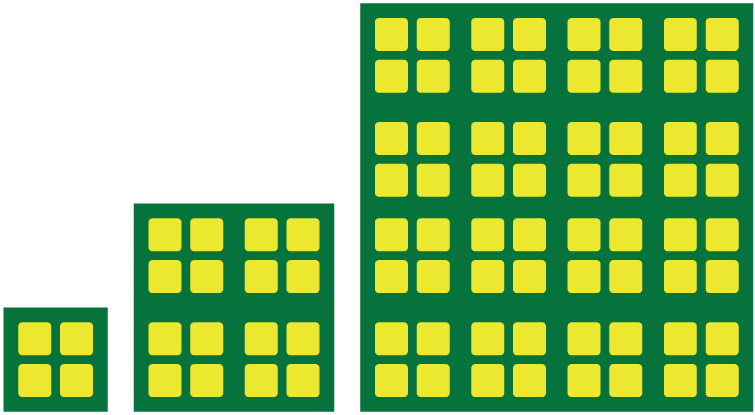
Each figure is built from square groups of tiles, and the groups grow larger from one figure to the next.Cada figura está armada con grupos cuadrados de fichas, y los grupos se hacen más grandes de una figura a la siguiente.
4Step 4 of 9:Paso 4 de 9:Watch meMírame
Watch me
I want to find the value of 2³.Quiero hallar el valor de 2³.
The small 3 tells me to multiply 2 by itself 3 times.El 3 pequeño me dice que multiplique 2 por sí mismo 3 veces.
So I write 2 × 2 × 2.Así que escribo 2 × 2 × 2.
First 2 × 2 = 4. Then 4 × 2 = 8.Primero 2 × 2 = 4. Luego 4 × 2 = 8.
So 2³ = 8.Entonces 2³ = 8.
5Step 5 of 9:Paso 5 de 9:Let’s do one togetherHagamos uno juntos
Before each step, say what you think comes next. Then show it.Antes de cada paso, di qué crees que sigue. Luego muéstralo.
Let's try together
Now let's find 5². How many times do we multiply 5 by itself?Ahora hallemos 5². ¿Cuántas veces multiplicamos 5 por sí mismo?
The exponent is 2, so we write 5 × 5.El exponente es 2, así que escribimos 5 × 5.
What is 5 × 5? Yes, 25. So 5² = 25.¿Cuánto es 5 × 5? Sí, 25. Entonces 5² = 25.
6Step 6 of 9:Paso 6 de 9:Your turnTu turno
Now it's your turn
In the table, write each power as repeated multiplication and find its value.En la tabla, escribe cada potencia como multiplicación repetida y halla su valor.
7Step 7 of 9:Paso 7 de 9:Check yourself: a first questionCompruébalo: una primera pregunta
8Step 8 of 9:Paso 8 de 9:Check yourself: a harder questionCompruébalo: una pregunta más difícil
9Step 9 of 9:Paso 9 de 9:Put it togetherJúntalo todo
Watch out for a common mistakeCuidado con un error común
A common mistake in Powers and Exponents is multiplying the base by the exponent instead of using the base as a repeated factor — for example, thinking 2³ = 2 × 3 = 6 instead of 2³ = 2 × 2 × 2 = 8. Before you submit, rewrite the power as repeated multiplication first, then multiply step by step.
Sentence frameMarco de oración
When the exponent increases by 1, the value is multiplied by ___ because the base is used as a factor ___ more time.Cuando el exponente aumenta en 1, el valor se multiplica por ___ porque la base se usa como factor ___ vez más.
Stage 3 of 5Etapa 3 de 5
PracticePractica
Choose Regular or Challenge. Hints come one step at a time; you get a new question after a worked example.Elige Regular o Reto. Las pistas llegan paso a paso; después de un ejemplo resuelto recibes una pregunta nueva.
Loading practice…
Stage 4 of 5Etapa 4 de 5
ApplyAplica
Use the idea in a real situation. Write your reasoning, then compare it with a sample.Usa la idea en una situación real. Escribe tu razonamiento y compáralo con un ejemplo.
Apply in context: Patio tilesAplica en contexto: Losetas del patio
A square patio is 6 feet long on each side. Its area in square feet is 6². Each square foot of tile costs $2. How much does the tile for the whole patio cost?Un patio cuadrado mide 6 pies de largo por cada lado. Su área en pies cuadrados es 6². Cada pie cuadrado de loseta cuesta $2. ¿Cuánto cuesta la loseta de todo el patio?
Step 1 · Guide mePaso 1 · Guíame
The patio has 6 rows of 6 square feet. What is its area?El patio tiene 6 filas de 6 pies cuadrados. ¿Cuál es su área?
square feetpies cuadrados
Step 2 · Final answerPaso 2 · Respuesta final
dollarsdólares
Real-world connectionConexión con el mundo real
A music studio is recording tracks. Each track layer doubles the file size. A single track is 4 MB. The file size after n layers is given by 4 × 2ⁿ.Un estudio de música está grabando pistas. Cada capa de pista duplica el tamaño del archivo. Una sola pista son 4 MB. El tamaño del archivo después de n capas está dado por 4 × 2ⁿ.
File Size Doubles Each LayerEl tamaño del archivo se duplica en cada capa
Each bar is 4 × 2ⁿ MB; every layer doubles the height, so the file races to 128 MB after 5 layers.Cada barra es 4 × 2ⁿ MB; cada capa duplica la altura, así que el archivo se dispara a 128 MB después de 5 capas.
Question:Pregunta:How large is the file after 5 layers? Why does the file size grow so quickly?¿De qué tamaño es el archivo después de 5 capas? ¿Por qué crece tan rápido el tamaño del archivo?
After 5 layers the file is MB because 4 × 2⁵ = 4 × = . The file grows quickly because each layer the size.Después de 5 capas el archivo es de MB porque 4 × 2⁵ = 4 × = . El archivo crece rápido porque cada capa el tamaño.
Reasoning challengeReto de razonamiento
A new song from the studio is shared online, and the number of shares doubles every hour. Starting with 1 share, write a power expression for the number of shares after 6 hours. Explain why exponential growth is so much faster than adding the same number each hour.Una canción nueva del estudio se comparte en internet, y la cantidad de veces que se comparte se duplica cada hora. Empezando con 1 vez, escribe una expresión con potencias para la cantidad de veces que se comparte después de 6 horas. Explica por qué el crecimiento exponencial es mucho más rápido que sumar la misma cantidad cada hora.
After 6 hours there are ___ shares because 2⁶ = ___. If it grew by adding 2 each hour instead, there would only be ___ shares. Exponential growth is faster because ___.
Create & verify: Explore Numerical Expressions with ExponentsCrea y verifica
Create a real-world growth or area pattern that uses an exponent (like 2⁵ or 3⁴). Write it in exponential form, expanded form, and standard form, and explain why 2⁵ is not 2 × 5.Crea un patrón real de crecimiento o área que use un exponente (como 2⁵ o 3⁴). Escríbelo en forma exponencial, desarrollada y estándar, y explica por qué 2⁵ no es 2 × 5.
Quick test bench (try numbers or expressions)Banco de prueba rápido (prueba números o expresiones)
Stage 5 of 5Etapa 5 de 5
ReflectReflexiona
Answer on your own. Your first try counts as independent evidence; you can still revise.Responde por tu cuenta. Tu primer intento cuenta como evidencia independiente; todavía puedes revisar.