Background knowledgeConocimientos previos2 skills you need for today: Adding 0 and multiplying by 1 · Group numbers in a friendly orderLas 2 destrezas que necesitas hoy: Sumar 0 y multiplicar por 1 · Agrupar números en un orden fácil
Properties of OperationsPropiedades de las operaciones:Rules that let you reorder or regroup numbers without changing an expression's value.Reglas que permiten reordenar o reagrupar números sin cambiar el valor de una expresión.
Read the words below.Lee las palabras de abajo.
Open the model and change one number at a time.Abre el modelo y cambia un número a la vez.
Answer the questions beside the model, one at a time.Responde las preguntas junto al modelo, una a la vez.
Words to knowPalabras clave
Commutative PropertyPropiedad conmutativa
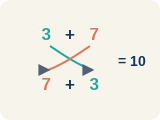
You can change the order and get the same answer.Puedes cambiar el orden y obtener la misma respuesta.
3 + 7 = 7 + 3 = 10 both ways; 4 × 5 = 5 × 4 = 20 both ways — order does not matter
Associative PropertyPropiedad asociativa
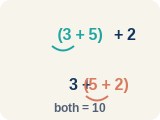
You can change the grouping and get the same answer.Puedes cambiar la agrupación y obtener la misma respuesta.
(2 + 3) + 4 = 5 + 4 = 9 and 2 + (3 + 4) = 2 + 7 = 9 — same answer, different grouping
Identity PropertyPropiedad de identidad
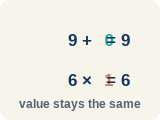
Adding 0 or multiplying by 1 keeps the same value.Sumar 0 o multiplicar por 1 mantiene el mismo valor.
9 + 0 = 9 (zero is the identity for addition); 6 × 1 = 6 (one is the identity for multiplication)
PropertyPropiedad
A rule that is always true in math.Una regla que siempre es verdadera en matemáticas.
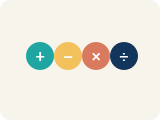
Commutative works for + and ×, but NOT for − or ÷ (since 5 − 3 = 2 but 3 − 5 = −2)
Loading the model…
1. Try this1. Prueba esto
Before you start: does (3 + 5) + 2 equal 3 + (5 + 2)? Predict, then move the parentheses.
Swap two numbers. Which property did you use?
Switch to × and try the same moves. Do they still work?
Add 0 (or multiply by 1). Why does the value stay the same?
3. Check yourself3. Compruébalo
Answer a question about your model, then one new problem without it.Responde una pregunta sobre tu modelo y luego un problema nuevo sin él.
Stage 2 of 5Etapa 2 de 5
UnderstandComprende
Read the idea, follow the worked examples, and connect the picture to the numbers.Lee la idea, sigue los ejemplos resueltos y conecta el dibujo con los números.
1Step 1 of 9:Paso 1 de 9:Words to knowPalabras clave
Say what each word means, then tap the card to check.Di qué significa cada palabra y luego toca la tarjeta para comprobar.
2Step 2 of 9:Paso 2 de 9:Check the wordsComprueba las palabras
3Step 3 of 9:Paso 3 de 9:What are the properties of operations?¿Cuáles son las propiedades de las operaciones?
Properties are math rules that are always true. The Commutative Property lets you change the order. The Associative Property lets you change the grouping (the parentheses).Las propiedades son reglas matemáticas que siempre se cumplen. La propiedad conmutativa te deja cambiar el orden. La propiedad asociativa te deja cambiar la agrupación (los paréntesis).
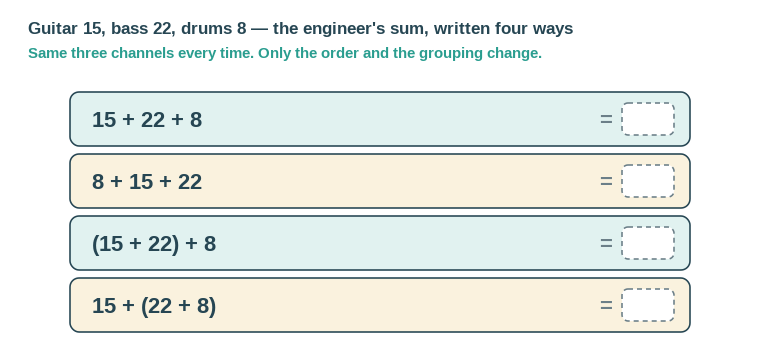
A sound engineer adds up the volume levels of three mixing-board channels: guitar at 15, bass at 22, and drums at 8. She writes the sum four ways: 15 + 22 + 8, 8 + 15 + 22, (15 + 22) + 8, and 15 + (22 + 8).Una ingeniera de sonido suma los niveles de volumen de tres canales de la mesa de mezclas: guitarra en 15, bajo en 22 y batería en 8. Escribe la suma de cuatro maneras: 15 + 22 + 8, 8 + 15 + 22, (15 + 22) + 8 y 15 + (22 + 8).
4Step 4 of 9:Paso 4 de 9:Watch meMírame
Watch me
I have 3 guitarists, 5 drummers, and 2 keyboard players.Tengo 3 guitarristas, 5 bateristas y 2 tecladistas.
I can add them as 3 + 5 + 2, which gives 10.Puedo sumarlos como 3 + 5 + 2, lo que da 10.
The Commutative Property says order does not matter: 5 + 3 + 2 also gives 10.La propiedad conmutativa dice que el orden no importa: 5 + 3 + 2 también da 10.
The Associative Property says grouping does not matter: (3 + 5) + 2 = 3 + (5 + 2), both equal 10.La propiedad asociativa dice que la agrupación no importa: (3 + 5) + 2 = 3 + (5 + 2), las dos dan 10.
5Step 5 of 9:Paso 5 de 9:Let’s do one togetherHagamos uno juntos
Before each step, say what you think comes next. Then show it.Antes de cada paso, di qué crees que sigue. Luego muéstralo.
Let's try together
Look at 6 + 9 and 9 + 6. Do they give the same total?Mira 6 + 9 y 9 + 6. ¿Dan el mismo total?
6 + 9 = 15 and 9 + 6 = 15. Yes, the same.6 + 9 = 15 y 9 + 6 = 15. Sí, lo mismo.
Only the order changed, so this shows the Commutative Property.Solo cambió el orden, así que esto muestra la propiedad conmutativa.
6Step 6 of 9:Paso 6 de 9:Your turnTu turno
Now it's your turn
Sort each example into the property it shows: commutative or associative.Clasifica cada ejemplo según la propiedad que muestra: conmutativa o asociativa.
Ask: did the order change, or did the grouping change?Pregúntate: ¿cambió el orden o cambió la agrupación?
7Step 7 of 9:Paso 7 de 9:Check yourself: a first questionCompruébalo: una primera pregunta
8Step 8 of 9:Paso 8 de 9:Check yourself: a harder questionCompruébalo: una pregunta más difícil
9Step 9 of 9:Paso 9 de 9:Put it togetherJúntalo todo
Watch out for a common mistakeCuidado con un error común
A common mistake in Properties of Operations is applying the commutative property where it does not belong, or confusing it with the associative property. Students often assume 15 − 8 = 8 − 15 (it does not: 7 ≠ −7 — commutative only works for addition and multiplication), or they see parentheses move and call it "associative" even when the numbers inside just swapped places, like (2 + 3) + 4 = (3 + 2) + 4 (that is commutative — the order inside the parentheses changed, not the grouping). Before you label a property, ask: did only the order change (commutative), did only the grouping change (associative), or was a 0 or 1 involved (identity)?
Sentence frameMarco de oración
The ___ property changes the ___, while the ___ property changes the ___. I can tell by looking at whether the ___ moved or the ___ changed.La propiedad ___ cambia ___, mientras que la propiedad ___ cambia ___. Lo puedo saber viendo si ___ se movió o si ___ cambió.
Stage 3 of 5Etapa 3 de 5
PracticePractica
Choose Regular or Challenge. Hints come one step at a time; you get a new question after a worked example.Elige Regular o Reto. Las pistas llegan paso a paso; después de un ejemplo resuelto recibes una pregunta nueva.
Loading practice…
Stage 4 of 5Etapa 4 de 5
ApplyAplica
Use the idea in a real situation. Write your reasoning, then compare it with a sample.Usa la idea en una situación real. Escribe tu razonamiento y compáralo con un ejemplo.
Apply in context: Shopping totalAplica en contexto: Total de la compra
Dana buys a notebook for $14, a folder for $23, and a pen for $6. She uses the commutative and associative properties to add 14 + 6 first, then adds the folder. What is her total cost?Dana compra un cuaderno por $14, una carpeta por $23 y un bolígrafo por $6. Usa las propiedades conmutativa y asociativa para sumar primero 14 + 6 y luego suma la carpeta. ¿Cuál es su costo total?
Step 1 · Guide mePaso 1 · Guíame
What is the notebook plus the pen, 14 + 6?¿Cuánto es el cuaderno más el bolígrafo, 14 + 6?
dollarsdólares
Step 2 · Final answerPaso 2 · Respuesta final
dollarsdólares
Real-world connectionConexión con el mundo real
A sound engineer needs to calculate 4 × 17 × 25 mentally to find the total cost of audio cables. Using the associative and commutative properties, she rearranges: 4 × 25 × 17 = 100 × 17.Una ingeniera de sonido necesita calcular 4 × 17 × 25 mentalmente para hallar el costo total de unos cables de audio. Usando las propiedades asociativa y conmutativa, reacomoda: 4 × 25 × 17 = 100 × 17.
Same Product, Friendlier OrderEl mismo producto, en un orden más amable
Both bars reach 1700: reordering 4 × 17 × 25 to 4 × 25 × 17 doesn't change the product, and pairing 4 × 25 = 100 makes the mental math easy.Las dos barras llegan a 1700: reacomodar 4 × 17 × 25 como 4 × 25 × 17 no cambia el producto, y juntar 4 × 25 = 100 hace fácil el cálculo mental.
Question:Pregunta:What properties did the engineer use, and why does rearranging make the calculation easier?¿Qué propiedades usó la ingeniera, y por qué reacomodar hace más fácil el cálculo?
The engineer used the property to change the and the property to change the . This makes it easier because 4 × 25 = , which is a friendly number to multiply by.La ingeniera usó la propiedad para cambiar y la propiedad para cambiar . Esto lo hace más fácil porque 4 × 25 = , que es un número amigable para multiplicar.
Reasoning challengeReto de razonamiento
Explain why the commutative property works for addition and multiplication but NOT for subtraction and division. Give a specific number example for each operation to prove your point.
Create & verify: Generate Equivalent ExpressionsCrea y verifica
Start with an algebraic expression and generate two different equivalent expressions using properties (Commutative, Associative, or Distributive). Name each property and check with a value.Parte de una expresión algebraica y genera dos expresiones equivalentes usando propiedades (Conmutativa, Asociativa o Distributiva). Nombra cada propiedad y comprueba con un valor.
Quick test bench (try numbers or expressions)Banco de prueba rápido (prueba números o expresiones)
Stage 5 of 5Etapa 5 de 5
ReflectReflexiona
Answer on your own. Your first try counts as independent evidence; you can still revise.Responde por tu cuenta. Tu primer intento cuenta como evidencia independiente; todavía puedes revisar.