Touch and changeToca y cambia
Move, type, tap, or drag in the model. Watch what changes.Mueve, escribe, toca o arrastra en el modelo. Observa qué cambia.
Unit 8 · Equations and InequalitiesUnidad 8 · Ecuaciones y desigualdades
TicketBoleto
At a rec-center raffle, a prize was divided equally among 4 friends. Each friend got $85. How much was the whole prize?En una rifa del centro recreativo, un premio se dividió por partes iguales entre 4 amigos. Cada amigo recibió $85. ¿Cuánto era el premio total?
Five short steps, about 15–20 minutes: watch the idea, try one together, solve 10 in three levels, check, celebrate.Cinco pasos cortos, unos 15–20 minutos: miren la idea, prueben uno juntos, resuelvan 10 en tres niveles, revisen y celebren.
Optional. No grades, no account. Your place is saved on this device.Opcional. Sin calificaciones ni cuenta. Su avance se guarda en este dispositivo.
Tonight's ideaLa idea de hoy Model real-world problems with equations and inequalities, then solve and check them.Representar problemas reales con ecuaciones y desigualdades, resolverlos y comprobarlos.
💡 Draw fraction bars, tape diagrams, equations, or line up decimals together!💡 ¡Dibujen barras de fracciones, modelos o alineen decimales juntos!
Step 1 of 5Paso 1 de 5
Read the goal and look at the picture. Then go through the example one step at a time.Lean la meta y miren el dibujo. Luego sigan el ejemplo un paso a la vez.
Model real-world problems with equations and inequalities, then solve and check them.
Representar problemas reales con ecuaciones y desigualdades, resolverlos y comprobarlos.
In class we usedEn clase usamos the equation-or-inequality checkla revisión: ¿ecuación o desigualdad?.
Why it worksPor qué funciona Multiplying 85 by 4 is the same step that solves t ÷ 4 = 85, so both give $340. The equation also names what is unknown, which helps in longer problems.Multiplicar 85 por 4 es el mismo paso que resuelve t ÷ 4 = 85, así que las dos formas dan $340. La ecuación también nombra lo desconocido, y eso ayuda en problemas más largos.
The example:El ejemplo: Clue: 'A total divided equally among 4 people gave each $85.'Pista: «Un total repartido por igual entre 4 personas le dio $85 a cada una.»
Your case:Su caso: Tonight we read a word problem and decide whether to model it with an equation or an inequality, then solve it and check that the answer makes sense.Esta noche leemos un problema verbal y decidimos si modelarlo con una ecuación o una desigualdad, luego lo resolvemos y revisamos que la respuesta tenga sentido.
Tap a clue to read what it means.Toquen una pista para leer qué significa.
Look at the picture and the story. Say it out loud, or type a few words. There is no wrong answer here.Mira el dibujo y la historia. Dilo en voz alta o escribe unas palabras. Aquí no hay respuestas incorrectas.
Just for you. It stays on this device. We ask again at the end.Solo para ti. Se queda en este dispositivo. Preguntamos otra vez al final.
x + 4 ≤ 10. What is the greatest whole number x can be?x + 4 ≤ 10. ¿Cuál es el mayor número entero que puede ser x?
Not yet. Try another look.Todavía no. Intenta otra mirada.
Subtract 4 from both sides: x ≤ 10 − 4 = 6. The greatest whole number is 6.Resta 4 de ambos lados: x ≤ 10 − 4 = 6. El mayor número entero es 6.
Solve: 6n = 54Resuelve: 6n = 54
Not yet. Try another look.Todavía no. Intenta otra mirada.
n is multiplied by 6, so divide both sides by 6: 54 ÷ 6 = 9.La n está multiplicada por 6, así que se divide ambos lados entre 6: 54 ÷ 6 = 9.
Step 2 of 5Paso 2 de 5
Do this one side by side. Use the model, and ask for a hint whenever you want one.Háganlo lado a lado. Usen el modelo y pidan una pista cuando quieran.
Try this one togetherPrueben este juntos
Detective Santos has a new clue: 'The lookout earned less than $50.' Model and solve it together.La detective Santos tiene una nueva pista: 'El vigilante ganó menos de $50.' Modélenla y resuélvanla juntos.
Equation or inequality? What in the clue tells you?¿Ecuación o desigualdad? ¿Qué parte de la pista lo indica?
An inequality — 'less than' is a limit, a range rather than one exact value.Una desigualdad — 'menos de' es un límite, un rango y no un valor exacto.
Underline 'less than' before choosing the model.Subrayen 'menos de' antes de elegir el modelo.
Model it. Let e be the earnings. What inequality says 'less than 50'?Modélenla. Que e sean las ganancias. ¿Qué desigualdad dice 'menos de 50'?
e < 50. 'Less than' does not include 50, so the symbol is <.e < 50. 'Menos de' no incluye el 50, así que el símbolo es <.
Write e < 50 on the paper.Escriban e < 50 en el papel.
Check reasonableness: is $30 a reasonable amount the lookout could have earned?Revisen la razonabilidad: ¿es $30 una cantidad razonable que el vigilante pudo ganar?
Yes — $30 is less than $50, so it fits the clue.Sí — $30 es menos de $50, así que cumple la pista.
Asking if the answer makes sense matters more than speed.Preguntar si la respuesta tiene sentido importa más que la rapidez.
Test boundary and interior points to verify the solution set.Prueba puntos en el límite y en el interior para verificar el conjunto solución.
Change one value. Watch what changes in the picture and answer.Cambia un valor. Mira qué cambia en el dibujo y la respuesta. Say: “When ___ changes, ___ changes.”Di: “Cuando ___ cambia, ___ cambia.”
Before you go on: say one thing the model showed you.Antes de seguir: digan una cosa que les mostró el modelo.
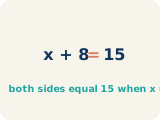
Change the equation. Keep both sides equal as you solve for the unknown.Cambia la ecuación. Mantén iguales los dos lados mientras hallas la incógnita.
Move, type, tap, or drag in the model. Watch what changes.Mueve, escribe, toca o arrastra en el modelo. Observa qué cambia.
Record one equation, value, or relationship you can see.Escribe una ecuación, un valor o una relación que puedas ver.
I notice ___ changes when ___ changes. This shows ___.Noto que ___ cambia cuando ___ cambia. Esto muestra ___.
Ask: "Where do you see the numbers from tonight's math in this model?"Pregunta: "¿Dónde ves los números de la tarea de hoy en este modelo?"
Model real-world problems with equations and inequalities, then solve and check them.
Representar problemas reales con ecuaciones y desigualdades, resolverlos y comprobarlos.
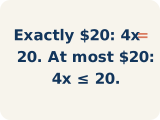
'Equals' or 'exactly' points to an equation (=); 'at least, at most, more than, fewer than' points to an inequality.
'Es igual a' o 'exactamente' apunta a una ecuación (=); 'al menos, a lo más, más que, menos que' apunta a una desigualdad.
Read the clue: "A total split equally among 4 people gave each $85." One exact total means an equation.
Lee la pista: «Un total repartido por igual entre 4 personas le dio $85 a cada una».
Un total exacto significa una ecuación.
Write the equation.
Escribe la ecuación.
Let t be the total: t ÷ 4 = 85.
Sea t el total: t ÷ 4 = 85.
Multiply both sides by 4 to undo dividing: t = 85 × 4 = 340.
Multiplica los dos lados por 4 para deshacer la división: t = 85 × 4 = 340.
Check that it makes sense: $340 split 4 ways is $85 each, because 340 ÷ 4 = 85.
Comprueba que tenga sentido: $340 repartidos entre 4 son $85 para cada uno, porque 340 ÷ 4 = 85.
Listen for "model" (modelar) — it means writing the real situation as math.
Escuchen la palabra "modelar" — significa escribir la situación real como matemática.
Listen for "reasonableness" (razonabilidad) — checking that the answer makes sense (no negative people, for example).
Escuchen la palabra "razonabilidad" — revisar que la respuesta tenga sentido (sin personas negativas, por ejemplo).
First ask "Equation or inequality?" Have them point to the signal words before solving.
Primero pregunten "¿Ecuación o desigualdad?" Que señalen las palabras clave antes de resolver.
Step 3 of 5Paso 3 de 5
One at a time. Work on your own; a grown-up can watch.Uno a la vez. Trabaja solo; un adulto puede observar.
10 problems. Hints are always okay. 10 problemas. Las pistas siempre están bien.
+0 bonusextraWhich clue gives a limit instead of one exact value? Say its key words out loud.
¿Qué pista da un límite en vez de un valor exacto? Di en voz alta tus palabras clave.
Which clue gives a limit instead of one exact value?
¿Qué pista da un límite en vez de un valor exacto?
at most points to an inequality, because it gives a limit.
a lo más apunta a una desigualdad, porque da un límite.
Which clue points to an inequality?¿Qué pista apunta a una desigualdad?
Answer key for families — compare, then talk about why.Clave de respuestas para la familia — comparen y hablen del porqué.
Not tried yet? Close this and give it one try first. A wrong first try still helps.¿Todavía no lo intentaron? Ciérrenla y hagan un intento primero. Un primer intento equivocado también ayuda.
Why:Por qué: at most points to an inequality, because it gives a limit.a lo más apunta a una desigualdad, porque da un límite.
At most means that number or fewer.
A lo más significa ese número o menos.
Can the bus carry fewer than 40?
¿El autobús puede llevar menos de 40?
r ≤ 40, because 40 riders or fewer fit.
r ≤ 40, porque caben 40 pasajeros o menos.
'A bus holds at most 40 riders.' Which model shows the riders r?'Un autobús lleva a lo más 40 pasajeros.' ¿Qué modelo muestra los pasajeros r?
Answer key for families — compare, then talk about why.Clave de respuestas para la familia — comparen y hablen del porqué.
Not tried yet? Close this and give it one try first. A wrong first try still helps.¿Todavía no lo intentaron? Ciérrenla y hagan un intento primero. Un primer intento equivocado también ayuda.
Why:Por qué: r ≤ 40, because 40 riders or fewer fit.r ≤ 40, porque caben 40 pasajeros o menos.
I always use = for a word problem.
Siempre uso = en un problema de palabras.
The clue word ___ means I use ___, so my model is ___.
La palabra clave ___ significa que uso ___, así que mi modelo es ___.
Equally means one exact amount, so use an equation: 6d = 120. Undo × 6 by dividing: d = 120 ÷ 6 = 20. Check: 6 × 20 = 120.
Por partes iguales significa una cantidad exacta, así que usa una ecuación: 6d = 120. Deshaz × 6 dividiendo: d = 120 ÷ 6 = 20. Comprueba: 6 × 20 = 120.
A coach splits a $120 team fund equally among 6 players. Each player gets d dollars. Which model and answer fit?Un entrenador reparte un fondo del equipo de $120 por partes iguales entre 6 jugadores. Cada jugador recibe d dólares. ¿Qué modelo y qué respuesta encajan?
Answer key for families — compare, then talk about why.Clave de respuestas para la familia — comparen y hablen del porqué.
Not tried yet? Close this and give it one try first. A wrong first try still helps.¿Todavía no lo intentaron? Ciérrenla y hagan un intento primero. Un primer intento equivocado también ayuda.
Why:Por qué: Equally means one exact amount, so use an equation: 6d = 120. Undo × 6 by dividing: d = 120 ÷ 6 = 20. Check: 6 × 20 = 120.Por partes iguales significa una cantidad exacta, así que usa una ecuación: 6d = 120. Deshaz × 6 dividiendo: d = 120 ÷ 6 = 20. Comprueba: 6 × 20 = 120.
Exactly gives one value.
Exactamente da un solo valor.
Is $12 a limit or an exact amount?
¿Los $12 son un límite o una cantidad exacta?
An equation, because exactly means equal.
Una ecuación, porque exactamente significa igual.
'Jo has exactly $12 to spend.' What kind of model fits?'Jo tiene exactamente $12 para gastar.' ¿Qué tipo de modelo corresponde?
Answer key for families — compare, then talk about why.Clave de respuestas para la familia — comparen y hablen del porqué.
Not tried yet? Close this and give it one try first. A wrong first try still helps.¿Todavía no lo intentaron? Ciérrenla y hagan un intento primero. Un primer intento equivocado también ayuda.
Why:Por qué: An equation, because exactly means equal.Una ecuación, porque exactamente significa igual.
Undo adding 9.
Deshaz sumar 9.
Is c the cost or the money left over?
¿c es el costo o el dinero que sobra?
c = $11, because 20 − 9 = 11.
c = $11, porque 20 − 9 = 11.
A pizza costs $9 and you pay with $20. Your change is c, so 9 + c = 20. What is c?Una pizza cuesta $9 y pagas con $20. Tu cambio es c, así que 9 + c = 20. ¿Cuánto es c?
Answer key for families — compare, then talk about why.Clave de respuestas para la familia — comparen y hablen del porqué.
Not tried yet? Close this and give it one try first. A wrong first try still helps.¿Todavía no lo intentaron? Ciérrenla y hagan un intento primero. Un primer intento equivocado también ayuda.
Why:Por qué: c = $11, because 20 − 9 = 11.c = $11, porque 20 − 9 = 11.
$5 is saved each week, so multiply by w.
Se ahorran $5 cada semana, así que multiplica por w.
Does at least mean 40 or more, or 40 or fewer?
¿Al menos significa 40 o más, o 40 o menos?
5w ≥ 40, because her savings must be $40 or more.
5w ≥ 40, porque sus ahorros deben ser $40 o más.
Maria saves $5 a week and wants at least $40. Which inequality shows the weeks w?María ahorra $5 por semana y quiere al menos $40. ¿Qué desigualdad muestra las semanas w?
Answer key for families — compare, then talk about why.Clave de respuestas para la familia — comparen y hablen del porqué.
Not tried yet? Close this and give it one try first. A wrong first try still helps.¿Todavía no lo intentaron? Ciérrenla y hagan un intento primero. Un primer intento equivocado también ayuda.
Why:Por qué: 5w ≥ 40, because her savings must be $40 or more.5w ≥ 40, porque sus ahorros deben ser $40 o más.
Undo multiplying with its opposite.
Deshaz multiplicar con su opuesto.
What is b multiplied by?
¿Por qué número está multiplicada b?
b = 7 boxes, because 42 ÷ 6 = 7.
b = 7 cajas, porque 42 ÷ 6 = 7.
A box holds 6 cans and you have 42 cans, so 6b = 42. How many boxes?Una caja tiene 6 latas y tienes 42 latas, así que 6b = 42. ¿Cuántas cajas?
Answer key for families — compare, then talk about why.Clave de respuestas para la familia — comparen y hablen del porqué.
Not tried yet? Close this and give it one try first. A wrong first try still helps.¿Todavía no lo intentaron? Ciérrenla y hagan un intento primero. Un primer intento equivocado también ayuda.
Why:Por qué: b = 7 boxes, because 42 ÷ 6 = 7.b = 7 cajas, porque 42 ÷ 6 = 7.
Easier problems to practice the idea. Do these first together. Problemas más fáciles para practicar la idea. Hagan estos primero juntos.
What makes your answer reasonable? Use the question to check it.
¿Por qué es razonable tu respuesta? Usa la pregunta para comprobarla.
Sort by the key operation or concept each item shows.
Marca el límite. Prueba ese valor y uno a cada lado; decide si incluyes el extremo.
Clues that name one exact total need an equation: the ransom split equally among 5 suspects at $40 each, the fingerprints plus 9 equaling 21, and the three identical safes holding exactly 75 coins. Clues with 'no more than', 'at least', or 'fewer than' mark a boundary rather than a single value, so those three need an inequality.
Las pistas que nombran un total exacto necesitan una ecuación: el rescate repartido en partes iguales entre 5 sospechosos a $40 cada uno, las huellas más 9 que dan 21, y las tres cajas fuertes idénticas con exactamente 75 monedas. Las pistas con 'no more than', 'at least' o 'fewer than' marcan un límite en vez de un solo valor, así que esas tres necesitan una desigualdad.
Room 1: The case board is a mess. Sort each clue into whether it needs an EQUATION (one exact total) or an INEQUALITY (a limit or range).Sala 1: El tablero del caso es un desorden. Clasifica cada pista según si necesita una ECUACIÓN (un total exacto) o una DESIGUALDAD (un límite o un rango).
Answer key for families — compare, then talk about why.Clave de respuestas para la familia — comparen y hablen del porqué.
Not tried yet? Close this and give it one try first. A wrong first try still helps.¿Todavía no lo intentaron? Ciérrenla y hagan un intento primero. Un primer intento equivocado también ayuda.
Why:Por qué: Clues that name one exact total need an equation: the ransom split equally among 5 suspects at $40 each, the fingerprints plus 9 equaling 21, and the three identical safes holding exactly 75 coins. Clues with 'no more than', 'at least', or 'fewer than' mark a boundary rather than a single value, so those three need an inequality.Las pistas que nombran un total exacto necesitan una ecuación: el rescate repartido en partes iguales entre 5 sospechosos a $40 cada uno, las huellas más 9 que dan 21, y las tres cajas fuertes idénticas con exactamente 75 monedas. Las pistas con 'no more than', 'at least' o 'fewer than' marcan un límite en vez de un solo valor, así que esas tres necesitan una desigualdad.
'At most,' 'at least,' 'above,' 'more than,' and 'fewer than' signal an inequality.
'A lo sumo', 'al menos', 'por encima de', 'más de' y 'menos de' señalan una desigualdad.
'Exactly,' 'equals,' and 'is' signal an equation.
'Exactamente', 'es igual a' y 'es' señalan una ecuación.
Words that pin down one exact value call for an equation: five boxes weighing 'exactly 60 pounds total' and 'a number plus 8 equals 20' each have a single answer. Words that set a limit or a range call for an inequality: a shelf that holds 'at most 30 books' allows 30 or fewer, and a temperature that must stay 'above 32 degrees' allows any value greater than 32.
Las palabras que fijan un solo valor exacto piden una ecuación: cinco cajas que pesan 'exactly 60 pounds total' y 'a number plus 8 equals 20' tienen cada una una sola respuesta. Las palabras que ponen un límite o un rango piden una desigualdad: un estante que sostiene 'at most 30 books' permite 30 o menos, y una temperatura que debe quedar 'above 32 degrees' permite cualquier valor mayor que 32.
Sort each problem: equation or inequality?Clasifica cada problema: ¿ecuación o desigualdad?
💡 'Exactly,' 'equals,' and 'is' signal an equation.'Exactamente', 'es igual a' y 'es' señalan una ecuación.
💡 'At most,' 'at least,' 'above,' 'more than,' and 'fewer than' signal an inequality.'A lo sumo', 'al menos', 'por encima de', 'más de' y 'menos de' señalan una desigualdad.
Answer key for families — compare, then talk about why.Clave de respuestas para la familia — comparen y hablen del porqué.
Not tried yet? Close this and give it one try first. A wrong first try still helps.¿Todavía no lo intentaron? Ciérrenla y hagan un intento primero. Un primer intento equivocado también ayuda.
Why:Por qué: Words that pin down one exact value call for an equation: five boxes weighing 'exactly 60 pounds total' and 'a number plus 8 equals 20' each have a single answer. Words that set a limit or a range call for an inequality: a shelf that holds 'at most 30 books' allows 30 or fewer, and a temperature that must stay 'above 32 degrees' allows any value greater than 32.Las palabras que fijan un solo valor exacto piden una ecuación: cinco cajas que pesan 'exactly 60 pounds total' y 'a number plus 8 equals 20' tienen cada una una sola respuesta. Las palabras que ponen un límite o un rango piden una desigualdad: un estante que sostiene 'at most 30 books' permite 30 o menos, y una temperatura que debe quedar 'above 32 degrees' permite cualquier valor mayor que 32.
Equal groups (boxes, bags) point to a multiplication model; 'at most' points to an inequality with the 'or equal' bar. Solve with the inverse operation.
Los grupos iguales (cajas, bolsas) apuntan a un modelo de multiplicación; 'a lo sumo' apunta a una desigualdad con la barra de 'o igual'. Resuelve con la operación inversa.
For each row: find the numbers, decide the operation from the story's clue words, then ask if the answer makes real-world sense.
En cada fila: halla los números, decide la operación con las palabras clave de la historia y luego pregunta si la respuesta tiene sentido en la vida real.
Each row goes story → model → solution → reasonableness check. Five equal boxes totaling 60 pounds is 5w = 60, so w = 12 pounds. 'At most 30 books' with 17 already on the shelf is 17 + b ≤ 30, so b ≤ 13 books. And 84 cookies split into bags of 12 is 12b = 84, so b = 7 bags. Each answer is checked by putting it back into the story: 7 bags of 12 really is 84 cookies.
Cada fila va de la historia al modelo, luego a la solución y por último a la comprobación de sentido. Cinco cajas iguales que suman 60 libras es 5w = 60, así que w = 12 libras. 'At most 30 books' con 17 ya en el estante es 17 + b ≤ 30, así que b ≤ 13 libros. Y 84 galletas repartidas en bolsas de 12 es 12b = 84, así que b = 7 bolsas. Cada respuesta se comprueba regresándola a la historia: 7 bolsas de 12 sí son 84 galletas.
Write a model, solve, and check reasonableness for each problem.Escribe un modelo, resuelve y comprueba que la respuesta sea razonable en cada problema.
| Word ProblemProblema verbal | ModelModelo | SolutionSolución | Reasonable?¿Es razonable? |
|---|---|---|---|
| Five identical boxes weigh a total of 60 pounds. How much does each box weigh?Cinco cajas iguales pesan un total de 60 libras. ¿Cuánto pesa cada caja? | 5w = 60 |
|
Yes — 12 pounds per box is reasonable.Sí: 12 libras por caja es razonable. |
| A shelf can hold at most 30 books. There are already 17 books. How many more can be added?Una repisa puede contener como máximo 30 libros. Ya tiene 17 libros. ¿Cuántos más se pueden agregar? | 17 + b ≤ 30 |
|
Yes — up to 13 more books fits.Sí: caben hasta 13 libros más. |
| A baker split 84 cookies equally into bags of 12. How many bags did she use?Una panadera repartió 84 galletas por igual en bolsas de 12. ¿Cuántas bolsas usó? | 12b = 84 |
|
Yes — 7 bags of 12 = 84 cookies.Sí: 7 bolsas de 12 = 84 galletas. |
Answer key for families — compare, then talk about why.Clave de respuestas para la familia — comparen y hablen del porqué.
Not tried yet? Close this and give it one try first. A wrong first try still helps.¿Todavía no lo intentaron? Ciérrenla y hagan un intento primero. Un primer intento equivocado también ayuda.
Why:Por qué: Each row goes story → model → solution → reasonableness check. Five equal boxes totaling 60 pounds is 5w = 60, so w = 12 pounds. 'At most 30 books' with 17 already on the shelf is 17 + b ≤ 30, so b ≤ 13 books. And 84 cookies split into bags of 12 is 12b = 84, so b = 7 bags. Each answer is checked by putting it back into the story: 7 bags of 12 really is 84 cookies.Cada fila va de la historia al modelo, luego a la solución y por último a la comprobación de sentido. Cinco cajas iguales que suman 60 libras es 5w = 60, así que w = 12 libras. 'At most 30 books' con 17 ya en el estante es 17 + b ≤ 30, así que b ≤ 13 libros. Y 84 galletas repartidas en bolsas de 12 es 12b = 84, así que b = 7 bolsas. Cada respuesta se comprueba regresándola a la historia: 7 bolsas de 12 sí son 84 galletas.
Try these once the warm-up feels easy. It's okay to use the steps and pictures. Intenten estos cuando el calentamiento sea fácil. Está bien usar los pasos y los dibujos.
Choose clue words on purpose: 'exactly' or 'in total' for your equation; 'at least', 'at most', or 'more than' for your inequality.
Escoge las palabras clave a propósito: 'exactamente' o 'en total' para tu ecuación; 'al menos', 'a lo sumo' o 'más de' para tu desigualdad.
Use the same situation twice: one question asks for an EXACT amount, the other sets a limit or a minimum.
Usa la misma situación dos veces: una pregunta pide una cantidad EXACTA y la otra fija un límite o un mínimo.
The two models differ because the two questions ask for different things. An equation fits when the situation names one exact amount, like 'I saved exactly $45', so it has a single solution. An inequality fits when the situation sets a minimum or a ceiling, like 'I need at least $45', so a whole range of values works. Same story, different clue words, different symbol.
Los dos modelos son distintos porque las dos preguntas piden cosas distintas. Una ecuación sirve cuando la situación nombra una cantidad exacta, como 'ahorré exactamente $45', así que tiene una sola solución. Una desigualdad sirve cuando la situación pone un mínimo o un tope, como 'necesito al menos $45', así que funciona todo un rango de valores. La misma historia, distintas palabras clave, distinto símbolo.
Create two word problems about the same situation: one that requires an equation and one that requires an inequality. Solve both and explain why the models are different.Crea dos problemas sobre la misma situación: uno que requiera una ecuación y otro que requiera una desigualdad. Resuelve los dos y explica por qué los modelos son diferentes.
Answer key for families — compare, then talk about why.Clave de respuestas para la familia — comparen y hablen del porqué.
Not tried yet? Close this and give it one try first. A wrong first try still helps.¿Todavía no lo intentaron? Ciérrenla y hagan un intento primero. Un primer intento equivocado también ayuda.
Why:Por qué: The two models differ because the two questions ask for different things. An equation fits when the situation names one exact amount, like 'I saved exactly $45', so it has a single solution. An inequality fits when the situation sets a minimum or a ceiling, like 'I need at least $45', so a whole range of values works. Same story, different clue words, different symbol.Los dos modelos son distintos porque las dos preguntas piden cosas distintas. Una ecuación sirve cuando la situación nombra una cantidad exacta, como 'ahorré exactamente $45', así que tiene una sola solución. Una desigualdad sirve cuando la situación pone un mínimo o un tope, como 'necesito al menos $45', así que funciona todo un rango de valores. La misma historia, distintas palabras clave, distinto símbolo.
'At most' calls for ≤ and 'more than' calls for >. An equals sign only fits when the answer is one exact value.
'A lo sumo' pide ≤ y 'más de' pide >. Un signo igual solo cuadra cuando la respuesta es un valor exacto.
For each row, compare the problem's clue words to the student's symbol: does 'at most' or 'more than' really match an equals sign?
En cada fila, compara las palabras clave del problema con el símbolo del estudiante: ¿de verdad 'a lo sumo' o 'más de' corresponden a un signo igual?
Row 1 is wrong: 'at most 500 gallons' is a ceiling, so the model needs 320 + g ≤ 500, which gives g ≤ 180. Row 2 is correct: six friends each paying $8 out of one shared total is t / 6 = 8, so t = 48. Row 3 is wrong: 'more than 5 laps' needs a strict >, so 2 + m > 5, giving m > 3.
La fila 1 está mal: 'at most 500 gallons' es un tope, así que el modelo necesita 320 + g ≤ 500, lo que da g ≤ 180. La fila 2 está bien: seis amigos que pagan $8 cada uno de un total compartido es t / 6 = 8, así que t = 48. La fila 3 está mal: 'more than 5 laps' necesita un > estricto, así que 2 + m > 5, lo que da m > 3.
Check each student's model. If wrong, write the correct model and solve.Revisa el modelo de cada estudiante. Si está mal, escribe el modelo correcto y resuelve.
| ProblemProblema | Student's ModelModelo del estudiante | Correct?¿Es correcto? | Fix (if needed)Corrección (si hace falta) |
|---|---|---|---|
| A tank holds at most 500 gallons. It has 320. How many more gallons can be added?Un tanque contiene como máximo 500 galones. Ya tiene 320. ¿Cuántos galones más se pueden agregar? | 320 + g = 500 |
|
'At most' needs ≤: 320 + g ≤ 500 → g ≤ 180'Como máximo' requiere ≤: 320 + g ≤ 500 → g ≤ 180 |
| Six friends split a pizza bill equally. Each paid $8. What was the total?Seis amigos repartieron una cuenta de pizza por igual. Cada uno pagó $8. ¿Cuál fue el total? | t / 6 = 8 |
|
Correct: t = 48Correcto: t = 48 |
| A runner must complete more than 5 laps. She has done 2. How many more does she need?Una corredora debe completar más de 5 vueltas. Ya dio 2. ¿Cuántas más necesita? | 2 + m = 5 |
|
'More than' needs >: 2 + m > 5 → m > 3'Más de' requiere >: 2 + m > 5 → m > 3 |
Answer key for families — compare, then talk about why.Clave de respuestas para la familia — comparen y hablen del porqué.
Not tried yet? Close this and give it one try first. A wrong first try still helps.¿Todavía no lo intentaron? Ciérrenla y hagan un intento primero. Un primer intento equivocado también ayuda.
Why:Por qué: Row 1 is wrong: 'at most 500 gallons' is a ceiling, so the model needs 320 + g ≤ 500, which gives g ≤ 180. Row 2 is correct: six friends each paying $8 out of one shared total is t / 6 = 8, so t = 48. Row 3 is wrong: 'more than 5 laps' needs a strict >, so 2 + m > 5, giving m > 3.La fila 1 está mal: 'at most 500 gallons' es un tope, así que el modelo necesita 320 + g ≤ 500, lo que da g ≤ 180. La fila 2 está bien: seis amigos que pagan $8 cada uno de un total compartido es t / 6 = 8, así que t = 48. La fila 3 está mal: 'more than 5 laps' necesita un > estricto, así que 2 + m > 5, lo que da m > 3.
“At most 20” means the safe can hold 20, or any number below 20, but never more.
«Como máximo 20» significa que la caja fuerte puede guardar 20, o cualquier número menor que 20, pero nunca más.
Inequality symbols come straight from word clues like “at most”, “no more than”, “at least”, and “more than”.
Los símbolos de desigualdad vienen directamente de palabras clave como «como máximo», «no más de», «por lo menos» y «más de».
'At most 20' means 20 or fewer, so x ≤ 20.
«Como máximo 20» significa 20 o menos, así que x ≤ 20.
Room 3: A sign warns, 'The safe holds at most 20 gold bars.' Which inequality models the number of bars x?Sala 3: un letrero advierte: 'La caja fuerte guarda como máximo 20 barras de oro'. ¿Qué desigualdad representa el número de barras x?
Answer key for families — compare, then talk about why.Clave de respuestas para la familia — comparen y hablen del porqué.
Not tried yet? Close this and give it one try first. A wrong first try still helps.¿Todavía no lo intentaron? Ciérrenla y hagan un intento primero. Un primer intento equivocado también ayuda.
Why:Por qué: 'At most 20' means 20 or fewer, so x ≤ 20.«Como máximo 20» significa 20 o menos, así que x ≤ 20.
Optional. Only if your student wants more — these are bonus problems. Opcional. Solo si tu estudiante quiere más — son problemas adicionales.
'More than 8' means the TOTAL of 3 + h sits on the big side of a strict inequality — not an equals sign.
'Más de 8' significa que el TOTAL de 3 + h queda del lado grande de una desigualdad estricta, no de un signo igual.
There are two time pieces: the 3 hours already worked and the extra hours h. Together they must pass 8 hours.
Hay dos partes de tiempo: las 3 horas ya trabajadas y las horas extra h. Juntas deben pasar de 8 horas.
3 hours plus additional hours h must be more than 8: 3 + h > 8. Solve: h > 5.
3 horas más las horas adicionales h deben ser más de 8: 3 + h > 8. Resuelve: h > 5.
A detective needs more than 8 hours to finish the investigation. She has already worked 3 hours. Which inequality represents the additional hours h she needs?Una detective necesita más de 8 horas para terminar la investigación. Ya trabajó 3 horas. ¿Qué desigualdad representa las horas adicionales h que necesita?
Answer key for families — compare, then talk about why.Clave de respuestas para la familia — comparen y hablen del porqué.
Not tried yet? Close this and give it one try first. A wrong first try still helps.¿Todavía no lo intentaron? Ciérrenla y hagan un intento primero. Un primer intento equivocado también ayuda.
Why:Por qué: 3 hours plus additional hours h must be more than 8: 3 + h > 8. Solve: h > 5.3 horas más las horas adicionales h deben ser más de 8: 3 + h > 8. Resuelve: h > 5.
Keep the sentence order — the number n comes first, then the division by 6, then 'equals 7'.
Conserva el orden de la oración: el número n va primero, luego la división entre 6 y luego 'es igual a 7'.
Spot the operation phrase: 'divided by 6'. That phrase gives you the symbol between n and 6.
Identifica la frase de operación: 'dividido entre 6'. Esa frase te da el símbolo entre n y 6.
Divided by 6 is n / 6. Equals 7 means = 7. So n / 6 = 7.
Dividido entre 6 es n / 6. Es igual a 7 significa = 7. Entonces n / 6 = 7.
Which model is correct for: 'A number divided by 6 equals 7'?¿Qué modelo es correcto para: 'Un número dividido entre 6 es igual a 7'?
Answer key for families — compare, then talk about why.Clave de respuestas para la familia — comparen y hablen del porqué.
Not tried yet? Close this and give it one try first. A wrong first try still helps.¿Todavía no lo intentaron? Ciérrenla y hagan un intento primero. Un primer intento equivocado también ayuda.
Why:Por qué: Divided by 6 is n / 6. Equals 7 means = 7. So n / 6 = 7.Dividido entre 6 es n / 6. Es igual a 7 significa = 7. Entonces n / 6 = 7.
'At most 48' allows exactly 48 but nothing above it, so you need the symbol with the 'or equal' bar, not > or =.
'A lo sumo 48' permite exactamente 48 pero nada por encima, así que necesitas el símbolo con la barra de 'o igual', no > ni =.
The bus already has 31 riders, and p more may board — but the TOTAL cannot pass 48.
El autobús ya lleva 31 pasajeros y pueden subir p más, pero el TOTAL no puede pasar de 48.
'At most 48' means the total must be ≤ 48. So 31 + p ≤ 48. Solve: p ≤ 17.
«Como máximo 48» significa que el total debe ser ≤ 48. Entonces 31 + p ≤ 48. Resuelve: p ≤ 17.
A bus can carry at most 48 passengers. There are already 31 on board. Which inequality shows how many more can board?Un autobús puede llevar como máximo 48 pasajeros. Ya hay 31 a bordo. ¿Qué desigualdad muestra cuántos más pueden subir?
Answer key for families — compare, then talk about why.Clave de respuestas para la familia — comparen y hablen del porqué.
Not tried yet? Close this and give it one try first. A wrong first try still helps.¿Todavía no lo intentaron? Ciérrenla y hagan un intento primero. Un primer intento equivocado también ayuda.
Why:Por qué: 'At most 48' means the total must be ≤ 48. So 31 + p ≤ 48. Solve: p ≤ 17.«Como máximo 48» significa que el total debe ser ≤ 48. Entonces 31 + p ≤ 48. Resuelve: p ≤ 17.
'Adding 12' means the model joins p and 12 with a plus sign, and the total 45 goes after the equals sign.
'Agregar 12' significa que el modelo une p y 12 con un signo más, y el total 45 va después del signo igual.
The museum STARTS with an unknown number of paintings p, then 12 more are ADDED to reach 45.
El museo EMPIEZA con un número desconocido de cuadros p y luego se AGREGAN 12 más para llegar a 45.
'Adding 12' to the original number gives 45: p + 12 = 45. Solve: p = 33.
«Agregar 12» al número original da 45: p + 12 = 45. Resuelve: p = 33.
A museum has some paintings. After adding 12, they have 45. Which equation models this?Un museo tiene algunas pinturas. Después de agregar 12, tiene 45. ¿Qué ecuación representa esta situación?
Answer key for families — compare, then talk about why.Clave de respuestas para la familia — comparen y hablen del porqué.
Not tried yet? Close this and give it one try first. A wrong first try still helps.¿Todavía no lo intentaron? Ciérrenla y hagan un intento primero. Un primer intento equivocado también ayuda.
Why:Por qué: 'Adding 12' to the original number gives 45: p + 12 = 45. Solve: p = 33.«Agregar 12» al número original da 45: p + 12 = 45. Resuelve: p = 33.
The 6 is being added to x, so undo it with the opposite operation, subtraction.
Al x se le está sumando 6, así que deshazlo con la operación contraria, la resta.
An equation is a balance — whatever you do to one side, you do to the other.
Una ecuación es un equilibrio: lo que le haces a un lado, se lo haces al otro.
Subtract 6 from both sides: x = 14 − 6 = 8. Check: 8 + 6 = 14 ✓
Resta 6 en los dos lados: x = 14 − 6 = 8. Comprueba: 8 + 6 = 14 ✓
Room 2: The vault keypad clue reads, 'A number of stolen coins plus 6 equals 14.' Solve x + 6 = 14 to find the code x.Sala 2: la pista del teclado de la bóveda dice: 'Un número de monedas robadas más 6 es igual a 14'. Resuelve x + 6 = 14 para hallar el código x.
Answer key for families — compare, then talk about why.Clave de respuestas para la familia — comparen y hablen del porqué.
Not tried yet? Close this and give it one try first. A wrong first try still helps.¿Todavía no lo intentaron? Ciérrenla y hagan un intento primero. Un primer intento equivocado también ayuda.
Why:Por qué: Subtract 6 from both sides: x = 14 − 6 = 8. Check: 8 + 6 = 14 ✓Resta 6 en los dos lados: x = 14 − 6 = 8. Comprueba: 8 + 6 = 14 ✓
Check the math first: multiply 4 by 13 and see if it rebuilds 52. Then judge whether that count fits a real box of notebooks.
Revisa primero las cuentas: multiplica 4 por 13 y ve si reconstruye 52. Luego juzga si esa cantidad cabe en una caja real de cuadernos.
'Reasonable' asks two things: does the math check out, AND does the number make sense for notebooks in a box?
'Razonable' pregunta dos cosas: ¿cuadran las cuentas Y tiene sentido ese número de cuadernos en una caja?
4 × 13 = 52 ✓. 13 notebooks per box is a reasonable whole number answer.
4 × 13 = 52 ✓. 13 cuadernos por caja es una respuesta razonable con un número entero.
A student solved 4n = 52 and got n = 13. Is the answer reasonable if n represents the number of notebooks in a box?Un estudiante resolvió 4n = 52 y obtuvo n = 13. ¿Es razonable la respuesta si n representa el número de cuadernos en una caja?
Answer key for families — compare, then talk about why.Clave de respuestas para la familia — comparen y hablen del porqué.
Not tried yet? Close this and give it one try first. A wrong first try still helps.¿Todavía no lo intentaron? Ciérrenla y hagan un intento primero. Un primer intento equivocado también ayuda.
Why:Por qué: 4 × 13 = 52 ✓. 13 notebooks per box is a reasonable whole number answer.4 × 13 = 52 ✓. 13 cuadernos por caja es una respuesta razonable con un número entero.
Divide both sides by 5 so that w is alone on one side.
Divide los dos lados entre 5 para que la w quede sola en un lado.
In 5w, the 5 and the w are multiplied, so undoing it takes the opposite operation.
En 5w, el 5 y la w se multiplican, así que deshacerlo requiere la operación contraria.
Divide both sides by 5: w = 60 ÷ 5 = 12 pounds. Check: 5 × 12 = 60 ✓
Divide los dos lados entre 5: w = 60 ÷ 5 = 12 libras. Comprueba: 5 × 12 = 60 ✓
Room 4: A locked drawer clue reads, 'Five identical evidence boxes weigh 60 pounds in all.' Solve 5w = 60 for each box's weight w.Sala 4: la pista de un cajón cerrado dice: 'Cinco cajas de evidencia idénticas pesan 60 libras en total'. Resuelve 5w = 60 para hallar el peso w de cada caja.
Answer key for families — compare, then talk about why.Clave de respuestas para la familia — comparen y hablen del porqué.
Not tried yet? Close this and give it one try first. A wrong first try still helps.¿Todavía no lo intentaron? Ciérrenla y hagan un intento primero. Un primer intento equivocado también ayuda.
Why:Por qué: Divide both sides by 5: w = 60 ÷ 5 = 12 pounds. Check: 5 × 12 = 60 ✓Divide los dos lados entre 5: w = 60 ÷ 5 = 12 libras. Comprueba: 5 × 12 = 60 ✓
Step 4 of 5Paso 4 de 5
See what each answer shows. Fix one, then try a fresh one.Vean qué muestra cada respuesta. Corrijan una y prueben una nueva.
Finish Your Turn first. Then this page shows what each answer tells us.Primero terminen Tu turno. Luego esta página muestra qué nos dice cada respuesta.
Step 5 of 5Paso 5 de 5
Celebrate what you did, see what it showed, then take one next step or stop here.Celebren lo que hicieron, vean lo que mostró y den un siguiente paso o paren aquí.
Saved only on this device. Your teacher has not received it.Se guarda solo en este dispositivo. Su maestro o maestra no lo ha recibido.
The last stepEl último paso
Compare it with how you felt at the start.Compáralo con cómo te sentías al empezar.
Weekends never break it. Saved only on this device.Los fines de semana no la interrumpen. Se guarda solo en este dispositivo.
Name one strategy that helped, or one question to ask next time. You can stop here; no adult signature is needed.
Di una estrategia que te ayudó o una pregunta para la próxima vez. Puedes terminar aquí; no necesitas la firma de un adulto.
Answers save automatically on this device. Tap Check This Problem anytime. Las respuestas se guardan solas en este dispositivo. Toquen Revisar esta pregunta cuando quieran.
These extras are not required. Photos, recordings and reflections stay on this device. To send anything to Mr. Neft, use ClassDojo.Estos extras no son obligatorios. Las fotos, grabaciones y reflexiones quedan en este dispositivo. Para enviar algo al Sr. Neft, usa ClassDojo.
Saved on:Guardado el:
🔥 1-Night StreakRacha de 1 noche
Question draft (not sent):Borrador de pregunta (no enviado):
Family reflection:Reflexión familiar:
Student Work Photo:Foto del trabajo:
Student Voice Memo:Nota de voz del estudiante:
A personal record of practice for . Saved on this device; not submitted to the teacher.
Practice partner (optional)
Date
Ask at the table
Which clue word told you to use = and which told you to use an inequality symbol?
Try it together
Find two situations at home. One has an exact amount (such as '4 plates with 3 forks on each, 12 forks in all') and one has a limit (such as 'the bag holds at most 5 apples'). Write one equation and one inequality, and circle the clue word that told you which to use.
To start talking
The clue word ___ means I use ___, so my model is ___.
Pregunten en la mesa
¿Qué palabra clave les dijo que usaran = y cuál les dijo que usaran un símbolo de desigualdad?
Prueben juntos
Busquen dos situaciones en casa. Una tiene una cantidad exacta (como '4 platos con 3 tenedores cada uno, 12 tenedores en total') y otra tiene un límite (como 'la bolsa tiene capacidad para a lo más 5 manzanas'). Escriban una ecuación y una desigualdad, y encierren la palabra clave que les dijo cuál usar.
Para empezar a hablar
La palabra clave ___ significa que uso ___, así que mi modelo es ___.
Which clue word told you to use = and which told you to use an inequality symbol?¿Qué palabra clave les dijo que usaran = y cuál les dijo que usaran un símbolo de desigualdad?
Start your answer like this:Empiecen su respuesta así: The clue word ___ means I use ___, so my model is ___.La palabra clave ___ significa que uso ___, así que mi modelo es ___.
A strong answer sounds like:Una respuesta sólida suena así: In class we first decide: one exact total means an equation, and a limit means an inequality. Here we write t ÷ 4 = 85 and multiply both sides by 4.En clase primero decidimos: un total exacto significa una ecuación, y un límite significa una desigualdad. Aquí escribimos t ÷ 4 = 85 y multiplicamos los dos lados por 4.
No grown-up nearby? Say your answer out loud to yourself, then write one sentence that proves it. Either language is fine.¿No hay un adulto cerca? Di tu respuesta en voz alta y escribe una oración que la pruebe. Sirve cualquiera de los dos idiomas.
I always use = for a word problem. Siempre uso = en un problema de palabras.
Grown-up: you will say one wrong answer, on purpose. Student: you are the math coach. Fix it, and explain why. Nothing is timed, and nobody has to know the answer first. Adulto: van a decir una respuesta equivocada, a propósito. Estudiante: tú eres el entrenador de matemáticas. Corrígela y explica por qué. Nada tiene cronómetro y nadie necesita saber la respuesta primero.
Round 1 of 3Ronda 1 de 3
The problem:El problema: Solve: x − 4 < 11Resuelve: x − 4 < 11
🎭 Grown-up says (out loud, with confidence):🎭 El adulto dice (en voz alta, con seguridad):
“I'm pretty sure the answer is x < 7.”“Estoy casi seguro de que la respuesta es x < 7.”
Your job: fix the answer. Which one is right?Tu trabajo: corregir la respuesta. ¿Cuál es la correcta?
🎉 You fixed it!¡Lo corregiste! Add 4 to both sides: x < 11 + 4 = 15. Graph: open circle at 15, shade left.Suma 4 a los dos lados: x < 11 + 4 = 15. Gráfica: círculo abierto en 15, sombrea a la izquierda.
Why this slip is easy to make:Por qué es fácil cometer este error: That subtracts 4 again instead of undoing the subtraction with addition.Eso resta 4 otra vez en lugar de deshacer la resta con una suma.
Question to ask next time:Pregunta para la próxima vez: What is being done to the letter? Say it, then say what undoes it.¿Qué se le está haciendo a la letra? Dilo, y luego di qué lo deshace.
Round 2 of 3Ronda 2 de 3
The problem:El problema: Solve: x + 6 > 14Resuelve: x + 6 > 14
🎭 Grown-up says (out loud, with confidence):🎭 El adulto dice (en voz alta, con seguridad):
“I'm pretty sure the answer is x < 8.”“Estoy casi seguro de que la respuesta es x < 8.”
Your job: fix the answer. Which one is right?Tu trabajo: corregir la respuesta. ¿Cuál es la correcta?
🎉 You fixed it!¡Lo corregiste! Subtract 6 from both sides: x > 14 − 6 = 8. Graph: open circle at 8, shade right.Resta 6 de los dos lados: x > 14 − 6 = 8. Gráfica: círculo abierto en 8, sombrea a la derecha.
Why this slip is easy to make:Por qué es fácil cometer este error: That flips the inequality direction, but subtracting the same number from both sides doesn't flip it.Eso invierte la dirección de la desigualdad, pero restar el mismo número a ambos lados no la invierte.
Question to ask next time:Pregunta para la próxima vez: Which kinds of moves can flip the symbol? Did we make one of those moves here?¿Qué tipos de pasos pueden voltear el símbolo? ¿Hicimos alguno de esos pasos aquí?
Round 3 of 3Ronda 3 de 3
The problem:El problema: Solve: x + 10 ≥ 25Resuelve: x + 10 ≥ 25
🎭 Grown-up says (out loud, with confidence):🎭 El adulto dice (en voz alta, con seguridad):
“I'm pretty sure the answer is x ≤ 15.”“Estoy casi seguro de que la respuesta es x ≤ 15.”
Your job: fix the answer. Which one is right?Tu trabajo: corregir la respuesta. ¿Cuál es la correcta?
🎉 You fixed it!¡Lo corregiste! Subtract 10 from both sides: x ≥ 25 − 10 = 15. Graph: closed circle at 15, shade right.Resta 10 de los dos lados: x ≥ 25 − 10 = 15. Gráfica: círculo cerrado en 15, sombrea a la derecha.
Why this slip is easy to make:Por qué es fácil cometer este error: That flips the inequality direction, but subtracting the same number from both sides doesn't flip it.Eso invierte la dirección de la desigualdad, pero restar el mismo número a ambos lados no la invierte.
Question to ask next time:Pregunta para la próxima vez: Which kinds of moves can flip the symbol? Did we make one of those moves here?¿Qué tipos de pasos pueden voltear el símbolo? ¿Hicimos alguno de esos pasos aquí?
Quick practice shows round 1. Choose Learn & practice for every round.La práctica breve muestra la ronda 1. Elijan Aprender y practicar para ver todas las rondas.
A planner who knows exactly 40 chairs are needed writes an equation, and one who knows the room fits at most 40 chairs writes an inequality. The words in the problem pick the model. Un organizador que sabe que se necesitan exactamente 40 sillas escribe una ecuación, y uno que sabe que el salón admite a lo más 40 sillas escribe una desigualdad. Las palabras del problema eligen el modelo.
Try it at homePruébenlo en casa
Find two situations at home. One has an exact amount (such as '4 plates with 3 forks on each, 12 forks in all') and one has a limit (such as 'the bag holds at most 5 apples'). Write one equation and one inequality, and circle the clue word that told you which to use.Busquen dos situaciones en casa. Una tiene una cantidad exacta (como '4 platos con 3 tenedores cada uno, 12 tenedores en total') y otra tiene un límite (como 'la bolsa tiene capacidad para a lo más 5 manzanas'). Escriban una ecuación y una desigualdad, y encierren la palabra clave que les dijo cuál usar.
Tonight's mystery challengeEl reto misterioso de hoy
Room 3: A sign warns, 'The safe holds at most 20 gold bars.' Which inequality models the number of bars x?Sala 3: un letrero advierte: 'La caja fuerte guarda como máximo 20 barras de oro'. ¿Qué desigualdad representa el número de barras x?
Locked. Finish 10 problems and it opens. Bloqueado. Termina 10 problemas y se abre.
1. Tap a card to flip it. 2. Play the quiz. 3. Match the words. 1. Toca una tarjeta para voltearla. 2. Haz la prueba. 3. Empareja las palabras.
Resolución de problemas con ecuaciones y desigualdades
Resolución de problemas con ecuaciones y desigualdades
Use = for one exact answer, or < or > for many answers.
ES Usar = para una respuesta exacta, o < o > para muchas respuestas.

Modelar
Modelar
Use math to show a real situation.
ES Usar matemáticas para mostrar una situación real.
Ecuación
Ecuación
A math sentence with an equal sign.
ES Una oración matemática con un signo de igual.

Desigualdad
Desigualdad
A math sentence that compares sides with <, >, ≤, or ≥.
ES Una oración matemática que compara lados con <, >, ≤ o ≥.

Razonabilidad
Razonabilidad
Checking that an answer makes sense.
ES Comprobar que una respuesta tiene sentido.

Variable
Variable
A letter that stands for a number.
ES Una letra que representa un número.
Restricción
Restricción
A rule an answer must follow.
ES Una regla que la respuesta debe cumplir.
Which word fits?¿Qué palabra encaja?
🎉 Quiz done!¡Prueba terminada!
First-try stars:Estrellas al primer intento:
Tap a word on the left, then tap its matching definition on the right! ¡Toca una palabra a la izquierda y su significado a la derecha!
Pick a game and play as a team. Nothing here is timed, and every game can be replayed as many times as you like. Escojan un juego y jueguen en equipo. Nada aquí tiene cronómetro, y pueden repetir cada juego cuantas veces quieran.
Try the recommended mission. Student: explain; partner: ask one question, then switch. Paper drawings work for every object. Prueba la misión recomendada. Estudiante: explica; acompañante: haz una pregunta, luego cambien. Puedes dibujar los objetos en papel.
One mission is enough. You can also work solo and explain in writing.Una misión es suficiente. También puedes trabajar a solas y explicar por escrito.
Find two situations at home. One has an exact amount (such as '4 plates with 3 forks on each, 12 forks in all') and one has a limit (such as 'the bag holds at most 5 apples'). Write one equation and one inequality, and circle the clue word that told you which to use.
Busquen dos situaciones en casa. Una tiene una cantidad exacta (como '4 platos con 3 tenedores cada uno, 12 tenedores en total') y otra tiene un límite (como 'la bolsa tiene capacidad para a lo más 5 manzanas'). Escriban una ecuación y una desigualdad, y encierren la palabra clave que les dijo cuál usar.
Show a labeled drawing, table, or equation. Your partner asks one question; working alone, write your explanation.
Muestra un dibujo con etiquetas, una tabla o una ecuación. Tu acompañante hace una pregunta; a solas, escribe tu explicación.
Choose ONE game. Quick Quiz practices this lesson; the other games review related skills. Play together or solo, without a timer. Elige UN juego. Reto rápido practica esta lección; los demás repasan temas relacionados. Juega acompañado o a solas, sin cronómetro.
Build a chain. The left side of each domino is the match for the problem on the end of the chain. Tap the domino that fits next. Armen una cadena. El lado izquierdo de cada ficha es la pareja del problema al final de la cadena. Toquen la ficha que encaja.
A student and a grown-up share one chain. Take turns placing, and switch coach and player each time. There is no winner and no timer.Un estudiante y un adulto comparten una cadena. Colocan fichas por turnos y cambian de entrenador y jugador cada vez. No hay ganador ni cronómetro.
🎉 Chain complete! The last problem links back to the first domino: a perfect loop.¡Cadena completa! El último problema conecta con la primera ficha: un círculo perfecto.
Take turns — student answers one, then a family member answers the next. Watch for the trick statements! Por turnos: el estudiante responde una y luego un familiar responde la siguiente. ¡Cuidado con las trampas!
Tap a card, then tap the bin it belongs in. Talk it through before you tap! Toquen una tarjeta y luego el cesto al que pertenece. ¡Conversen antes de tocar!
Everyone votes and says WHY. Then tap to see what the math says — sometimes it is a tie! Todos votan y dicen POR QUÉ. Luego toquen para ver qué dicen las matemáticas: ¡a veces es empate!
🔎 What the math saysLo que dicen las matemáticas
Reinforce tonight's topic with a quick family game. You ask; your student decides! Refuercen el tema de hoy con un juego rápido en familia. ¡Ustedes preguntan; su estudiante decide!
🎮 Play together! Test values: substitute to see if the inequality is true. 🎮 ¡Jueguen juntos! Prueben valores: sustituyan para ver si la desigualdad es verdadera.
The bigger review game for tonight's lesson — sort, match and choose. A wrong answer gives a hint and lets your student try again. No timer. El juego de repaso más grande para la lección de hoy — clasificar, emparejar y elegir. Si se equivocan, reciben una pista y lo intentan otra vez. Sin cronómetro.
Use this as a photobooth for the work itself: point the camera at tonight's notebook page, the scratchpad or the whiteboard and take the picture — or pose holding it up. Choose a frame, add stickers, then download it, print it, or add it to your optional reflection. The photo is never uploaded; it stays on this device. Úsenla como cabina de fotos del trabajo: apunten la cámara a la página del cuaderno, al borrador o a la pizarra y tomen la foto, o posen sosteniéndola. Elijan un marco, agreguen calcomanías y luego descárguenla, imprímanla o agréguenla a la reflexión opcional. La foto nunca se sube a internet; se queda en este dispositivo.
Camera Ready!¡Cámara lista!
Tap “Start Camera” to photograph tonight’s work, or use “Upload Work” below. The photo stays on this device.Toca “Iniciar Cámara” para fotografiar el trabajo de hoy, o usa “Subir Foto”. La foto se queda en este dispositivo.
Holding your open notebook or paper up next to your smile makes the best shot! You can also snap a photo of just your written work. ¡Sostener el cuaderno abierto junto a su sonrisa crea la mejor foto! También pueden tomar la foto solo de su trabajo escrito.
What words give the clue — 'equals/exactly' or 'at least/at most/more than/fewer than'?
¿Qué palabras dan la pista — 'es igual a/exactamente' o 'al menos/a lo más/más que/menos que'?
Let's write the model first, then solve it step by step.
Escribamos primero el modelo, luego resolvámoslo paso a paso.
Does the answer make sense for real life? Could it be negative or a half person?
¿La respuesta tiene sentido en la vida real? ¿Podría ser negativa o media persona?
Every word problem is an equation, so always use the equal sign.
Todo problema verbal es una ecuación, así que usa siempre el signo igual.
'At most 200' means exactly 200, so use =.
'A lo más 200' significa exactamente 200, así que usa =.
Once you get a number, you're done — no need to check if it makes sense.
Una vez que obtienes un número, ya terminaste — no hace falta revisar si tiene sentido.
These links go to specific videos about tonight's topic — not general math pages. Estos enlaces van a videos específicos sobre el tema de hoy — no a páginas generales.
Family Math Studio
Lesson 8.76.AT.8
Equations and Inequalities Problem Solving
Model real-world problems with equations and inequalities, then solve and check them.
NameDate
Tonight's spark
At a rec-center raffle, a prize was divided equally among 4 friends. Each friend got $85. How much was the whole prize?
Guess first: is the whole prize more than $85, or less?
Try it
Work it out on paper. Write one answer on each line.
Which clue points to an inequality?
My answer
'Jo has exactly $12 to spend.' What kind of model fits?
My answer
'A bus holds at most 40 riders.' Which model shows the riders r?
My answer
A pizza costs $9 and you pay with $20. Your change is c, so 9 + c = 20. What is c?
My answer
Maria saves $5 a week and wants at least $40. Which inequality shows the weeks w?
My answer
Talk about it
Which clue word told you to use = and which told you to use an inequality symbol?
Home mission
Look at a store receipt. Say, "A total of $24 was split equally among 4 people." Can your student say if that is an equation or an inequality? Then try "at most $24."
If we get stuck, ask
Family Math Studio
Lección 8.76.AT.8
Resolver problemas con ecuaciones y desigualdades
Representar problemas reales con ecuaciones y desigualdades, resolverlos y comprobarlos.
NombreFecha
La chispa de hoy
En una rifa del centro recreativo, un premio se dividió por partes iguales entre 4 amigos. Cada amigo recibió $85. ¿Cuánto era el premio total?
Primero adivina: ¿el premio total es mayor o menor que $85?
Inténtalo
Resuélvelo en papel. Escribe una respuesta en cada línea.
¿Qué pista apunta a una desigualdad?
Mi respuesta
'Jo tiene exactamente $12 para gastar.' ¿Qué tipo de modelo corresponde?
Mi respuesta
'Un autobús lleva a lo más 40 pasajeros.' ¿Qué modelo muestra los pasajeros r?
Mi respuesta
Una pizza cuesta $9 y pagas con $20. Tu cambio es c, así que 9 + c = 20. ¿Cuánto es c?
Mi respuesta
María ahorra $5 por semana y quiere al menos $40. ¿Qué desigualdad muestra las semanas w?
Mi respuesta
Conversen
¿Qué palabra clave les dijo que usaran = y cuál les dijo que usaran un símbolo de desigualdad?
Misión en casa
Miren un recibo de una tienda. Digan: «Un total de $24 se dividió por partes iguales entre 4 personas». ¿Puede su estudiante decir si es una ecuación o una desigualdad? Después prueben con «como máximo $24».
Si se atoran, pregunten