Background knowledgeConocimientos previos2 skills you need for today: Find the value of a power · Multiply before you add or subtractLas 2 destrezas que necesitas hoy: Hallar el valor de una potencia · Multiplicar antes de sumar o restar
Write and Evaluate Numerical Expressions with ExponentsEscribir y evaluar expresiones numéricas con exponentes:Turning a situation into a number sentence without an equal sign, then finding its value in the correct order.Convertir una situación en una expresión numérica sin signo de igual y luego hallar su valor en el orden correcto.
Read the words below.Lee las palabras de abajo.
Open the model and change one number at a time.Abre el modelo y cambia un número a la vez.
Answer the questions beside the model, one at a time.Responde las preguntas junto al modelo, una a la vez.
Words to knowPalabras clave
Numerical expressionExpresión numérica
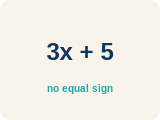
A math phrase built from numbers and operations, with no equal sign and no variable.Una frase matemática hecha de números y operaciones, sin signo de igual y sin variable.
4 × 20 is an expression; 4 × 20 = 80 is an equation
EvaluateEvaluar
To find the single value an expression is worth by carrying out its operations in order.Hallar el único valor que representa una expresión, realizando sus operaciones en orden.
Evaluate 3 + 2 × 4 → 3 + 8 = 11
Order of operationsOrden de las operaciones
The agreed order for evaluating: grouping symbols, then exponents, then multiply and divide left to right, then add and subtract left to right.El orden acordado para evaluar: signos de agrupación, luego exponentes, luego multiplicar y dividir de izquierda a derecha, y por último sumar y restar de izquierda a derecha.
3 + 4 × 2² → 3 + 4 × 4 → 3 + 16 = 19
PowerPotencia
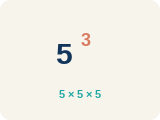
A short way to write repeated multiplication of the same factor, such as 2³ for 2 × 2 × 2.Una forma corta de escribir la multiplicación repetida del mismo factor, como 2³ para 2 × 2 × 2.
2³ = 2 × 2 × 2 = 8
Loading the model…
1. Try this1. Prueba esto
Compare 3⁴ with 3 × 4. Expand the power to explain the difference.
Predict 2 + 3⁴ before evaluating. Which operation comes first?
Change the exponent by one and explain the multiplicative effect on the power.
3. Check yourself3. Compruébalo
Answer a question about your model, then one new problem without it.Responde una pregunta sobre tu modelo y luego un problema nuevo sin él.
Read the idea, follow the worked examples, and connect the picture to the numbers.Lee la idea, sigue los ejemplos resueltos y conecta el dibujo con los números.
1Step 1 of 9:Paso 1 de 9:Words to knowPalabras clave
Say what each word means, then tap the card to check.Di qué significa cada palabra y luego toca la tarjeta para comprobar.
2Step 2 of 9:Paso 2 de 9:Check the wordsComprueba las palabras
3Step 3 of 9:Paso 3 de 9:Write the expression, then evaluate it in orderEscribe la expresión y luego evalúala en orden
A numerical expression is a math phrase made of numbers and operations, with no equal sign. Writing one for a whole situation keeps every part visible; evaluating it means finding its single value, following the order of operations.Una expresión numérica es una frase matemática hecha de números y operaciones, sin signo igual. Escribir una para toda la situación mantiene visible cada parte; evaluarla significa hallar su único valor, siguiendo el orden de las operaciones.
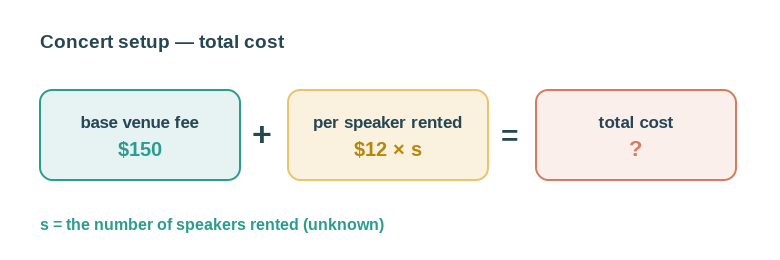
You are the music producer from the story. Your concert cost is given by the expression 150 + 12s, where s is the number of speakers you rent.Tú eres el productor musical de la historia. El costo de tu concierto está dado por la expresión 150 + 12s, donde s es el número de bocinas que rentas.
4Step 4 of 9:Paso 4 de 9:Watch meMírame
Watch me price the theater order
Sofia buys 2 member tickets at $15, 4 non-member tickets at $20, and 8 student tickets at $2 each. I write one expression for each ticket type: 2 × 15, 4 × 20, and 8 × 2.Sofía compra 2 boletos de socio a $15, 4 boletos de no socio a $20 y 8 boletos de estudiante a $2 cada uno. Escribo una expresión para cada tipo de boleto: 2 × 15, 4 × 20 y 8 × 2.
The whole order is the three costs added together: 2 × 15 + 4 × 20 + 8 × 2.El pedido completo son los tres costos sumados: 2 × 15 + 4 × 20 + 8 × 2.
Now I evaluate. There are no grouping symbols and no powers yet, so multiplication comes first, left to right: 30 + 80 + 16.Ahora evalúo. No hay símbolos de agrupación ni potencias todavía, así que la multiplicación va primero, de izquierda a derecha: 30 + 80 + 16.
Then I add: 30 + 80 + 16 = 126. The tickets cost $126.Luego sumo: 30 + 80 + 16 = 126. Los boletos cuestan $126.
5Step 5 of 9:Paso 5 de 9:Let’s do one togetherHagamos uno juntos
Before each step, say what you think comes next. Then show it.Antes de cada paso, di qué crees que sigue. Luego muéstralo.
Let's do one together
Suppose the student tickets cost 2³ dollars each instead of $2. The expression becomes 2 × 15 + 4 × 20 + 8 × 2³.Supongamos que los boletos de estudiante cuestan 2³ dólares cada uno en lugar de $2. La expresión se vuelve 2 × 15 + 4 × 20 + 8 × 2³.
Powers come before multiplying, so evaluate 2³ first: 2 × 2 × 2 = 8.Las potencias van antes de multiplicar, así que evalúa 2³ primero: 2 × 2 × 2 = 8.
Now multiply, left to right: 30 + 80 + 64.Ahora multiplica, de izquierda a derecha: 30 + 80 + 64.
Then add: 30 + 80 + 64 = 174. The order now costs $174.Luego suma: 30 + 80 + 64 = 174. Ahora el pedido cuesta $174.
6Step 6 of 9:Paso 6 de 9:Your turnTu turno
Your turn
Seven friends split a bill. The pizzas cost 3² dollars each and they order 4 of them, plus a $6 delivery fee.Siete amigos dividen la cuenta. Las pizzas cuestan 3² dólares cada una y piden 4, más $6 de envío.
Write ONE numerical expression for the total bill.Escribe una sola expresión numérica para la cuenta total.
Evaluate it: which do you handle first, the power or the multiplication?Evalúala: ¿qué haces primero, la potencia o la multiplicación?
Then divide the total among the 7 friends, and say what each step meant.Luego divide el total entre los 7 amigos y di qué significó cada paso.
7Step 7 of 9:Paso 7 de 9:Check yourself: a first questionCompruébalo: una primera pregunta
8Step 8 of 9:Paso 8 de 9:Check yourself: a harder questionCompruébalo: una pregunta más difícil
9Step 9 of 9:Paso 9 de 9:Put it togetherJúntalo todo
Watch out for a common mistakeCuidado con un error común
A common mistake with powers is multiplying the base by the exponent: reading 3² as 3 × 2 = 6 instead of 3 × 3 = 9. A second is evaluating strictly left to right, so 3 + 4 × 2 becomes 14 instead of 11. The order of operations exists so one expression has exactly one value: grouping symbols, then powers, then × and ÷ left to right, then + and − left to right.
Sentence frameMarco de oración
The correct value is ___ because ___ comes before ___. Without an agreed order, the same expression would have ___ values.El valor correcto es ___ porque ___ va antes que ___. Sin un orden acordado, la misma expresión tendría ___ valores.
Stage 3 of 5Etapa 3 de 5
PracticePractica
Choose Regular or Challenge. Hints come one step at a time; you get a new question after a worked example.Elige Regular o Reto. Las pistas llegan paso a paso; después de un ejemplo resuelto recibes una pregunta nueva.
Loading practice…
Stage 4 of 5Etapa 4 de 5
ApplyAplica
Use the idea in a real situation. Write your reasoning, then compare it with a sample.Usa la idea en una situación real. Escribe tu razonamiento y compáralo con un ejemplo.
Apply in context: Mosaic borderAplica en contexto: Borde del mosaico
A mosaic has 5 rows with 5 tiles in each row. A border adds 3 more tiles. Write an expression that uses a power, then evaluate it. How many tiles are in the mosaic?Un mosaico tiene 5 filas con 5 azulejos en cada fila. Un borde agrega 3 azulejos más. Escribe una expresión que use una potencia y luego evalúala. ¿Cuántos azulejos tiene el mosaico?
Step 1 · Guide mePaso 1 · Guíame
How many tiles are in the 5-by-5 square part?¿Cuántos azulejos hay en la parte cuadrada de 5 por 5?
tilesazulejos
Step 2 · Final answerPaso 2 · Respuesta final
tilesazulejos
Real-world connectionConexión con el mundo real
A rideshare app charges $2.50 plus $1.75 per mile. The expression for the fare is 2.50 + 1.75m, where m is miles traveled. Your friend lives 8 miles away.Una app de viajes cobra $2.50 más $1.75 por milla. La expresión de la tarifa es 2.50 + 1.75m, donde m son las millas recorridas. Tu amigo vive a 8 millas.
Rideshare Fare by MilesTarifa del viaje según las millas
Each bar shows 2.50 + 1.75m evaluated for that many miles; substitute m = 8 to get the $16.50 fare, and see the base $2.50 plus $1.75 for every mile.Cada barra muestra 2.50 + 1.75m evaluado para esa cantidad de millas; sustituye m = 8 para obtener la tarifa de $16.50, y observa la base de $2.50 más $1.75 por cada milla.
Question:Pregunta:How much will the ride cost? How does the expression model this situation?¿Cuánto costará el viaje? ¿Cómo modela la expresión esta situación?
The ride costs $ because 2.50 + 1.75() = . The 2.50 is the and 1.75 is the .El viaje cuesta $ porque 2.50 + 1.75() = . El 2.50 es la y 1.75 es la .
Reasoning challengeReto de razonamiento
Seven friends split the bill for a pizza party. They order 4 pizzas at 3² dollars each, plus a one-time $6 delivery fee. Write ONE numerical expression for what each friend owes, evaluate it, and explain why the grouping symbols matter.Siete amigos dividen la cuenta de una fiesta de pizza. Piden 4 pizzas a 3² dólares cada una, más un cargo único de entrega de $6. Escribe UNA expresión numérica para lo que debe cada amigo, evalúala y explica por qué importan los símbolos de agrupación.
Create & verify: Write and Evaluate Numerical Expressions with ExponentsCrea y verifica
Write a numerical expression that uses parentheses, an exponent, multiplication, and addition/subtraction. Evaluate it step by step using the order of operations.Escribe una expresión numérica que use paréntesis, un exponente, multiplicación y suma o resta. Evalúala paso a paso usando el orden de las operaciones.
Quick test bench (try numbers or expressions)Banco de prueba rápido (prueba números o expresiones)
Stage 5 of 5Etapa 5 de 5
ReflectReflexiona
Answer on your own. Your first try counts as independent evidence; you can still revise.Responde por tu cuenta. Tu primer intento cuenta como evidencia independiente; todavía puedes revisar.